
Passing HSK 4 or HSK 5 gives you a false sense of security. You open your first native Chinese web novel on Jinjiang (晋江) or Qidian (起点), full of excitement—and within two paragraphs, you are drowned in unfamiliar idioms, flowery adjectives, and poetic character names.
This experience is so common the language community has a name for it: the Intermediate Cliff. Textbook Chinese uses sanitized, standardized vocabulary. Native web novelists, by contrast, write with poetic flair, internet slang, and genre-specific jargon.
The good news? You do not need to know 10,000 characters before enjoying native Chinese fiction. You just need the right reading strategy and tools.
The 'Intermediate Cliff' in Chinese
Why do web novels feel so much harder than graded readers?
- Descriptive Prose (环境与神态描写): Authors describe furrowed eyebrows (眉头微蹙), fluttering robes (衣袂飘飘), and subtle emotional shifts using 4-character idioms (成语).
- Low Frequency, High Genre Vocabulary: In Xianxia (cultivation), you must know terms like dantian (丹田), qi deviation (走火入魔), and spiritual roots (灵根). In modern Danmei or romance, you encounter office hierarchies and youth slang.
- Pacing & Stamina: Web novels are long—often between 300,000 to 2,000,000 characters. Trying to look up every third word causes mental exhaustion after 15 minutes.
1. Selecting Your First Novel: Genre Difficulty Tiers
The single biggest mistake learners make is starting with high-fantasy Historical Xianxia (e.g., Mo Dao Zu Shi or Tian Guan Ci Fu). While wonderful, they contain heavy classical Chinese syntax (文言文 influences).
| Tier | Genre | Why it's suitable | Recommended Titles |
|---|---|---|---|
| Tier 1 (Easiest) | Modern Slice-of-Life / Campus Romance (现代校园) | 90% colloquial dialogue, everyday vocabulary, minimal idioms. | 《撒野》 (Run Freely / Sa Ye), 《小蘑菇》 (Little Mushroom - sci-fi, accessible prose) |
| Tier 2 (Moderate) | Unlimited Flow / Infinite Horror (无限流) or Modern Mystery | Fast-paced plots, goal-driven narration, contextual survival vocabulary. | 《地球上线》 (The Earth is Online), 《全球高考》 (Global Examination) |
| Tier 3 (Advanced) | Historical Cultivation / Wuxia / Court Politics (修真 / 权谋) | Classical grammar, heavy metaphor, historical titles, archaic idioms. | 《魔道祖师》 (Grandmaster of Demonic Cultivation), 《天官赐福》 (TGCF) |
2. Extensive vs. Intensive Reading: The 80/20 Rule
To finish a novel, you must balance two reading modes:
Extensive Reading (泛读) — 80% of your time
Your goal is narrative flow and enjoyment. If you understand 70–80% of a paragraph and know who is speaking to whom, do not stop to look up every unknown adjective. Let your brain infer meaning from context. This builds real reading speed and instinctual grammar comprehension.
Intensive Reading (精读) — 20% of your time
Pick one chapter or scene every few days. Look up recurring words, analyze how sentences are structured, and capture key phrases. If a character repeatedly uses a phrase or an idiom appears three times across two chapters, that word has earned your attention.
3. Conquering Chengyu & Cultural Tropes
Chinese idioms (成语, chéngyǔ) are 4-character condensations of historical anecdotes or philosophical observations. Treating them as four disconnected characters will confuse you.
When you see a 4-character block, don't look up each character separately. Inspect the idiom as a single lexical unit. For example:
- 莫名其妙 (mò míng qí miào): Baffling, inexplicable (lit. "unable to describe its mystery").
- 心不在焉 (xīn bù zài yān): Absent-minded (lit. "the heart is not here").
- 无可奈何 (wú kě nài hé): Having no alternative / helpless.
A good reading assistant will detect the 4-character boundary automatically rather than breaking it into individual dictionary entries.
4. Navigating Jinjiang (JJWXC) & Anti-Piracy Images
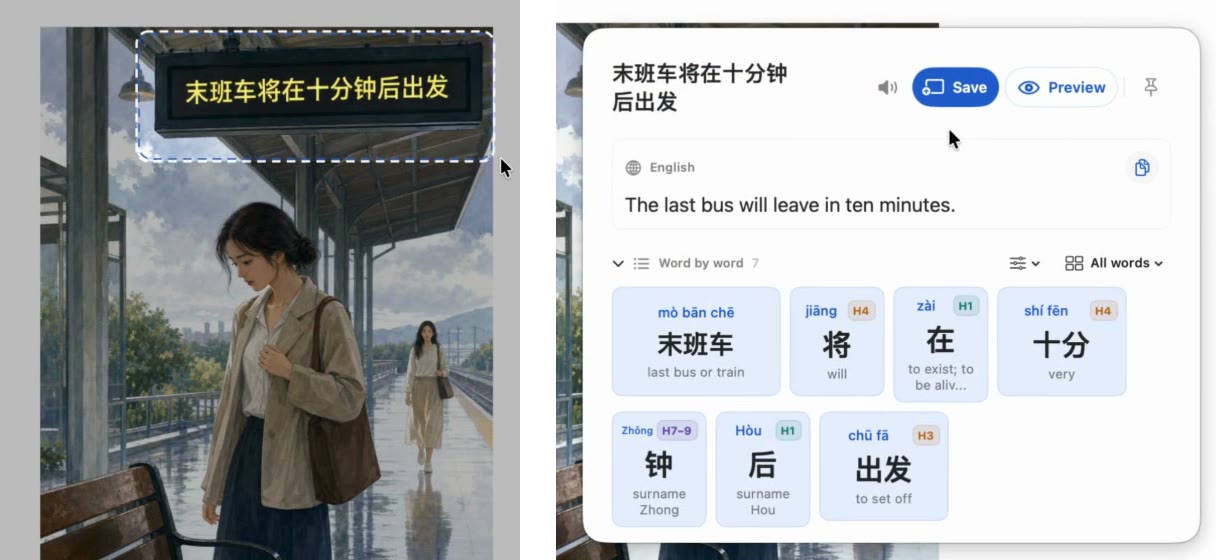
Many official publishing platforms (especially Jinjiang) employ anti-crawler defenses: VIP chapters often replace text characters with random SVGs or inline image slices. Additionally, many readers read imported EPUBs, PDFs, or reader apps where DOM-based browser plugins cannot select text.
The Solution: Use an on-device screen OCR tool. With Zhenzhu's Snip to Translate or hover recognition, you can draw a rapid box over any protected chapter, image, or scan. The OCR recognizes the Chinese characters on your Mac in milliseconds and presents the pinyin, definition, and translation without breaking your reading stride.
5. The Frictionless Desktop Reading Setup
To read comfortably for hours on your Mac:
- Choose a comfortable reader: Use an e-reader app (like Apple Books or Kindle for Mac) with an eye-friendly serif or songti font (e.g., 宋体 or 楷体) at 18px+ size.
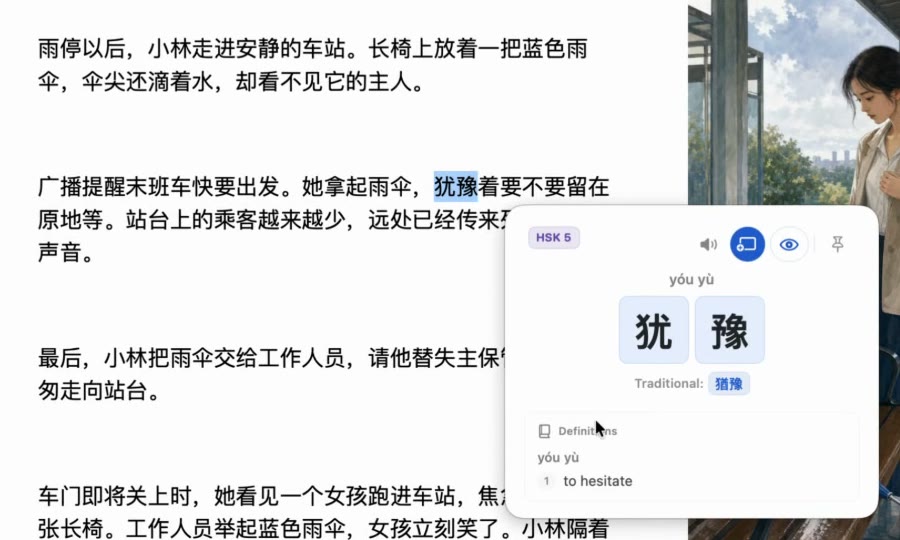
- Set up one-key lookup: Configure Zhenzhu with a comfortable hotkey (like
Option + Spaceor double-tap shortcut) or enable automatic selection popup. - Mine 5–10 cards per session: Don't hoard 100 cards a day. Save 5 to 10 high-value sentences with Zhenzhu's 1-click Anki or local FSRS card creator. Quality of context always beats quantity of flashcards.
Read Chinese on your Mac without friction
Selection lookup, on-device OCR, pinyin tone marks, HSK context, and 1-click Anki export. Try Zhenzhu Free today on macOS 15+.