
If you ask advanced Chinese readers what propelled them past the intermediate plateau, almost all of them will give the same answer: sentence mining. But if you ask why people abandon spaced repetition within 60 days, the culprit is almost always the same: mining the wrong sentences.
Mining without a strict selection filter turns your flashcard deck into a graveyard of obscure 50-character novelistic run-on sentences, archaic adjectives, and multi-word puzzles you dread seeing each morning. Before long, review queues swell to 300 cards a day, retention plummets below 70%, and you quit.
Sentence mining is an art of aggressive curation. Here is the definitive guide on how to identify, filter, and design high-retention i+1 sentences from native Chinese media so that every card you create feels effortless to review.
1. The Core Philosophy: Words in the Wild
Why do pre-made HSK decks fail to produce natural reading fluency? Because language is not a database of 1-to-1 vocabulary mappings. In Chinese especially, characters and words have enormous semantic elasticity:
- Collocations dictate meaning: A word like 敷衍 (fū yan) means "to go through the motions" or "to do something perfunctorily," but memorizing the English word "perfunctory" will never teach you how native speakers use it with particles (
敷衍了事,敷衍我,敷衍地笑了笑). - Syntactic anchors: Seeing how a word sits next to grammatical markers like
把,被,哪怕……也, or与其……不如trains your intuitive parsing muscle without memorizing abstract grammar rules. - Emotional & situational imprint: When you mine a sentence from a tense climax in a web novel or a laugh-out-loud moment in a comedy drama, your episodic memory anchors the lexical meaning. When that card appears in Anki three weeks later, the entire scene flashes in your mind instantly.
2. The Golden Standard: What Makes an Ideal i+1 Sentence?
In second-language acquisition, linguist Stephen Krashen popularized the formula i+1 (often called a 1T or "one-target" sentence in the immersion community). It describes input that contains everything you already comprehend (i), plus exactly one new element (+1).
An ideal Chinese mined sentence satisfies four strict criteria:
1. Exactly One Unknown Word (The Strict 1T Rule)
If a sentence contains two unfamiliar words, do not mine it. When a card has multiple unknowns, your brain splits focus. You might remember Word A on Tuesday and forget Word B, then remember Word B on Friday and forget Word A. You will mark the card "Again" repeatedly, creating a leech that ruins your review rhythm.
2. The "Shortness" Rule (10 to 25 Characters)
Keep your sentences short. In native novels, authors love flowing, descriptive 60-character compound sentences. If you mine the entire paragraph, reading the card during review takes 15 seconds. If you review 20 such cards, Anki becomes an exhausting chore.
Pro tip: Strip out non-essential preamble clauses. Keep only the core clause that contains the target word and enough context to make its usage unmistakable.
3. Self-Contained Context
The sentence must make sense on its own. If it relies on pronouns whose referents are ambiguous (e.g., "She told him that it wasn't there anymore"), you will struggle to remember what it was about. Choose sentences where the subject and situation are self-evident.
4. Natural, Modern Phrasing
Prioritize sentences that sound like spoken or natural contemporary written Chinese. Avoid sentences filled with archaic classical grammatical inversions unless you are explicitly studying Classical Chinese (文言文).
3. What NOT to Mine: The 5 Traps of Review Hell
Knowing what to reject is twice as important as knowing what to keep. Guard your deck ruthlessly against these five card-killers:
- Character Names & Fantasy Titles: In Danmei or Xianxia, you will encounter characters with complex names like 澹台烬 or sect ranks like 首席大弟子. Mining character names or made-up martial arts techniques wastes review bandwidth on words with zero transferability.
- Esoteric Onomatopoeia (拟声词): Chinese fiction loves vivid sound descriptions: 窸窸窣窣 (rustling), 滴滴答答 (pattering), 乒乒乓乓 (clattering). Unless an onomatopoeia is ubiquitous (like 哈哈 or 扑通), leave it in the book. Context will always provide the meaning when you read.
- Isolated Dictionary Examples: Never copy a sterilised example sentence out of a dictionary if you didn't encounter it in real immersion. If you didn't experience the sentence organically, it carries no emotional weight.
- Unclear Grammar You Can't Parse: If you know all the individual characters but the overall sentence structure makes no sense to you, the sentence is not i+1—it is an unrecognized grammar pattern. Do not mine it as a vocabulary card.
- The "I Might Need This Someday" Trap: If you run into a word describing the copper fitting on an ancient carriage wheel, ask yourself: "Will I see this word again in the next 100,000 characters?" If the answer is no, let it go.
4. Sentence Comparison: Good vs. Bad Cards
To see the difference in practice, look at how the same target word can result in either an exhausting card or a frictionless memory anchor:
| Aspect | ❌ Low-Yield / Problematic Card | ✅ High-Yield / Ideal i+1 Card |
|---|---|---|
| Sentence | 他那令人难以捉摸的眼神中透出一丝不易察觉的犹豫,仿佛在暗自揣度着对方深不可测的动机。 (44 chars, 3 unknowns) | 他眼神里透出一丝犹豫,最终还是放下了手中的杯子。 (24 chars, 1 unknown) |
| Target Word | 犹豫 (yóu yù — hesitation) | 犹豫 (yóu yù — hesitation) |
| Cognitive Load | Must parse 难以捉摸, 揣度, and 深不可测 before answering. | Target word is the sole focal point; surrounding context is effortless. |
| Review Speed | 15–20 seconds (fatiguing) | 3–4 seconds (fluid) |
| Retention | Poor: fails whenever you forget any of the secondary words. | High: clean, durable association with the core feeling. |
Here is what an optimal mined card looks like inside your review queue:
他连头都没抬,只是敷衍地应了一声。
Focus: 敷衍
to act perfunctorily; to go through the motions; half-hearted.
"He didn't even lift his head, merely giving a perfunctory nod of acknowledgment."
5. High-Yield Mining Sources by Level
Where should you go hunting for i+1 sentences? Your media choice must match your current comprehension comfort zone (the HSK levels below are rough guides; HSK 3.0 moved many words between levels, see HSK 3.0 vs 2.0):
Level 1: Lower-Intermediate (HSK 3–4 / 1,000–2,000 words)
- Modern Slice-of-Life Manhua (快看漫画, 哔哩哔哩漫画): Comic dialogues are short, colloquial, and heavily reinforced by visual storytelling. Look for high school romance or comedy genres where speech bubbles rarely exceed 15 characters.
- Xiaohongshu (小红书) Lifestyle & Food Captions: Authentic everyday Chinese, rich in modern lifestyle vocabulary, short bullet points, and high image context.
- Graded Readers (Sinolingua, Mandarin Companion): Mine the few unfamiliar words in level 3/4 readers to cement your foundation before jumping into unadapted novels.
Level 2: Mid-Intermediate (HSK 4–5 / 2,000–4,000 words)
- Modern Campus & Workplace Web Novels (晋江文学城 / 现代校园): Authors write accessible, dialogue-heavy prose. Recommended starter titles include 《撒野》 (Sa Ye) or modern mysteries where dialogue outpaces poetic descriptions.
- Contemporary TV Dramas with Chinese Subtitles: Slice-of-life dramas (like 《去有风的地方》 Meet Yourself) offer natural conversational sentences with high frequency.
- Bilibili Vlogs & Video Essays: Tech reviews, travel vlogs, and cooking channels provide clear spoken Mandarin with hardcoded Chinese subtitles. See how to make Anki cards from hardcoded Chinese subtitles.
Level 3: Upper-Intermediate to Advanced (HSK 6+ / 4,000+ words)
- Genre Fiction (Danmei, Xianxia, Sci-Fi): Authors like Priest, Mo Xiang Tong Xiu, or Liu Cixin offer rich idioms, figurative language, and specialized vocabulary.
- Zhihu (知乎) Long-form Answers & Essays: Intellectual discussions, cultural debates, and opinion pieces featuring high-register vocabulary and nuanced connective phrases.
- Mandarin Podcasts: Shows like 《声东击西》, 《忽左忽右》, or 《日知录》 provide complex spoken discourse for capturing native turns of phrase.
6. Card Design & Retention: Pinyin, Audio, and C-C Transition
Recognition vs. Production: Why Reading Recognition Wins
Many beginners design English-to-Chinese or cloze-deletion recall cards, attempting to force active writing or speech. For intermediate immersion, this is a mistake.
Your bottleneck when reading native Chinese is character recognition speed and lexical breadth. Recognition cards (Chinese sentence on the front → Pinyin and definition on the back) take 3 seconds to review, allowing you to consume 100 reviews in 6 minutes. Active recall cards take 15 seconds and induce severe mental friction. Save production for output practice; use sentence mining to expand your receptive comprehension.
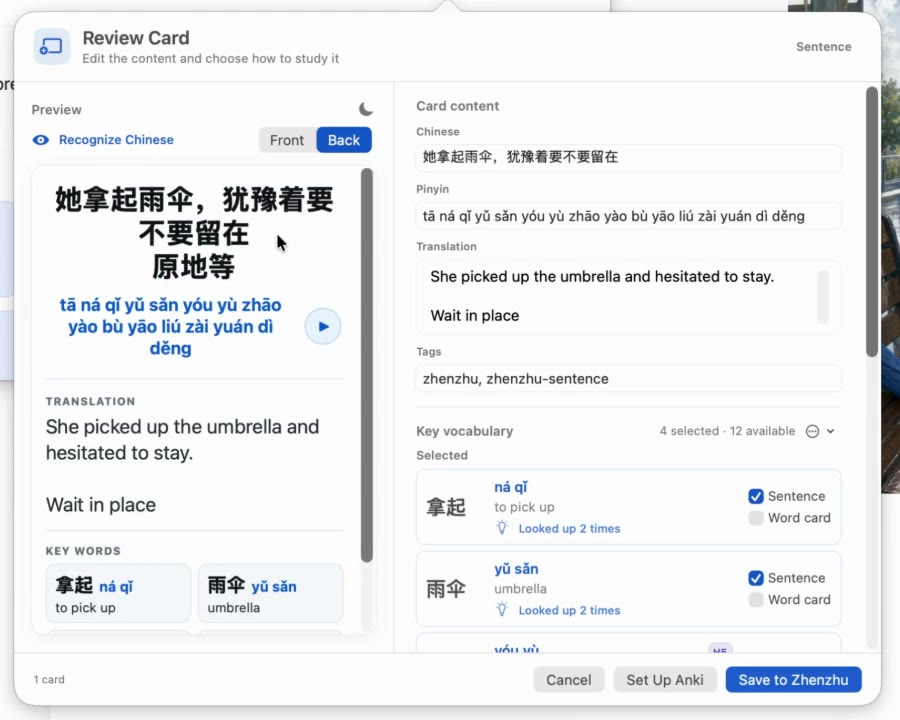
The Critical Role of Full-Sentence Audio
Chinese is a tonal language with extensive sandhi rules (e.g., the tone shifts of 不 and 一, or consecutive third tones). Reading characters silently can reinforce incorrect tonal assumptions. Whenever possible, include clear audio on the back of your card.
With tools like Zhenzhu, native macOS high-fidelity speech synthesis can pronounce the full sentence and the target word with accurate sandhi, cementing the natural cadence into your auditory memory.
When to Switch to Monolingual (Chinese-to-Chinese) Cards
Once you reach ~3,500 to 4,000 known words (comfortable HSK 5), begin incorporating Chinese-Chinese dictionary definitions (such as 现代汉语规范词典). C-C definitions stop you from filtering Chinese through English conceptual models and teach you the exact nuances of synonyms (such as the delicate difference between 琢磨, 揣摩, and 体味).
7. The Sustainable Routine: The 5-to-10 Rule
The single greatest hazard in sentence mining is over-mining during bursts of enthusiasm. You read a chapter, get excited, and mine 35 cards in an afternoon. Four days later, your Anki backlog hits 150 reviews, you fall behind, and you stop opening the app.
Adopt the 80/20 reading split:
- 80% Extensive Flow: Read for enjoyment. Ignore words that don't block comprehension. Let the story carry you forward.
- 20% Intentional Harvest: When a recurring, evocative word appears in a clean, self-contained sentence, hit your shortcut. Use Zhenzhu to capture the sentence, inspect the breakdown, and send it to your local FSRS deck or Anki in one second.
- Never break the reading momentum: If card creation takes more than 2 clicks, you will subconsciously avoid words to protect your flow. Streamline your toolchain so mining feels as natural as turning the page.
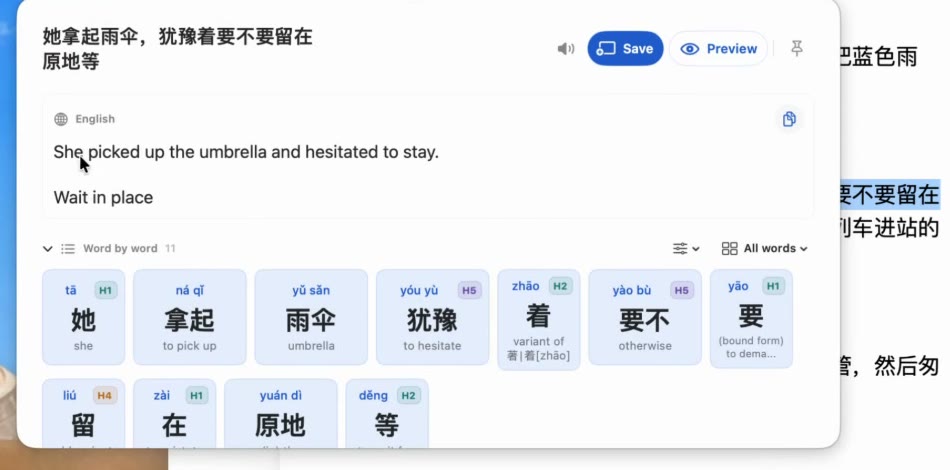
Read Chinese on your Mac without friction
Selection lookup, on-device OCR, pinyin tone marks, HSK context, and 1-click Anki export. Try Zhenzhu Free today on macOS 15+.