HSK 3.0 replaces the six-level HSK with nine levels in three stages, and its first worldwide exam is on 13 December 2026. The word lists changed far more than the level names suggest: of the 4,991 words in HSK 2.0, 2,461 sit at a different level in HSK 3.0, and someone who knows every HSK 2.0 Level 1–6 word knows only 59% of HSK 3.0 Levels 1–6.
Most articles on the change describe the new format and quote the headline word counts. This one goes a level deeper. We lined up the two official lists word by word and counted where every word went. The numbers below come from that comparison, and you can check any word, or a whole Anki deck, with our free HSK 2.0 → 3.0 checker.
The short answer
- When: the first official HSK 3.0 exam worldwide is on 13 December 2026. Sessions before that date still use the HSK 2.0 syllabus, and from 2027 HSK 3.0 becomes the standard test.
- Structure: "three stages, nine levels": elementary (1–3), intermediate (4–6) and advanced (7–9). Levels 7, 8 and 9 share one exam and one word list.
- Vocabulary: every level from 1 to 5 asks for more words than before. HSK 1 alone doubles, from 150 to 300 words.
- The surprise: it isn't just more words. Hundreds of familiar words changed level in both directions, and 1,529 old HSK 6 words now belong to Level 7-9.
Word counts, old and new
HSK 2.0 had 5,000 words over six levels. The HSK 3.0 exam syllabus published in November 2025 sets cumulative targets of 300, 500, 1,000, 2,000, 3,600 and 5,400 words for Levels 1 to 6, and 11,000 for Levels 7-9. The last column shows the distinct written words we counted in the official list for each level.
| Level | HSK 2.0 (cumulative) | HSK 3.0 target (cumulative) | HSK 3.0 words at this level (our count) |
|---|---|---|---|
| 1 | 150 | 300 | 300 |
| 2 | 300 | 500 | 197 |
| 3 | 600 | 1,000 | 491 |
| 4 | 1,200 | 2,000 | 990 |
| 5 | 2,500 | 3,600 | 1,579 |
| 6 | 5,000 | 5,400 | 1,777 |
| 7-9 | none | 11,000 | 5,555 |
Our per-level counts add up to slightly less than the targets (10,889 against 11,000). We count each distinct written word once, while the targets are round figures, so expect small gaps at every level.
What moved: the word-level data
Here is every HSK 2.0 word, grouped by its old level (rows) and its new level (columns). Read along a row to see where an old level's words went.
| HSK 2.0 ↓ / 3.0 → | 1 | 2 | 3 | 4 | 5 | 6 | 7-9 | Not listed |
|---|---|---|---|---|---|---|---|---|
| Level 1 | 143 | 3 | 0 | 0 | 1 | 0 | 0 | 3 |
| Level 2 | 55 | 70 | 13 | 0 | 3 | 0 | 0 | 6 |
| Level 3 | 7 | 34 | 226 | 20 | 0 | 1 | 0 | 10 |
| Level 4 | 3 | 5 | 55 | 463 | 53 | 5 | 2 | 12 |
| Level 5 | 2 | 2 | 12 | 113 | 769 | 254 | 121 | 25 |
| Level 6 | 0 | 0 | 0 | 13 | 155 | 679 | 1,529 | 124 |
| Not in 2.0 | 90 | 83 | 185 | 381 | 598 | 838 | 3,903 |
What the grid says:
- 2,350 words kept their level (the bold diagonal). 2,461 changed: 456 moved to a lower level, so you meet them sooner, and 2,005 moved higher, 1,529 of them from Level 6 into 7-9.
- 180 HSK 2.0 words have no HSK 3.0 level. Often a different form replaced them. 唱歌 (chàng gē, to sing) is gone, but 唱 and 歌 are Level 1 words. 冬 (dōng, winter) gave way to 冬天 (dōng tiān). Some names left too, such as 北京 and 长城.
- 6,078 HSK 3.0 words were never in HSK 2.0, 3,903 of them at Level 7-9. Even Level 1 has 90 of them, though 89 of those 90 use only characters that appear in HSK 2.0 Level 1–2 words: 他们 (tā men) builds on 他, 这儿 (zhèr) on 这.
- Old knowledge covers about half of the new levels. If you know all of HSK 2.0 Levels 1–N, here is how much of HSK 3.0 Levels 1–N you already have:
| You know HSK 2.0 Levels… | HSK 3.0 words in the same range | Of those, you already know |
|---|---|---|
| 1 | 300 | 143 (48%) |
| 1–2 | 497 | 271 (55%) |
| 1–3 | 988 | 551 (56%) |
| 1–4 | 1,978 | 1,097 (55%) |
| 1–5 | 3,557 | 2,052 (58%) |
| 1–6 | 5,334 | 3,159 (59%) |
That is the most useful single number for planning: finishing an HSK 2.0 course gets you a bit over half of the same HSK 3.0 levels, whichever level you stop at.
Level by level
Each level has its own page with the moved, new and dropped words, pinyin and meanings.
HSK 1
143 of the 150 old Level 1 words stayed. 67 came down from higher levels, including family words such as 哥哥 (gē ge) and 姐姐 (jiě jie) from Level 2, and 饺子 (jiǎo zi, dumpling) from Level 4. 小姐 (xiǎo jie) moved up to Level 5 while 女士 (nǚ shì) came down from Level 5. HSK 1: 2.0 vs 3.0.
HSK 2
The most reshuffled small level: only 70 of the 147 old Level 2 words are still Level 2, and 55 moved down to Level 1. New words include colour words with 色: 白色, 红色 and 黑色 are Level 2, while the bare characters 白, 红 and 黑 moved up to Level 5. HSK 2: 2.0 vs 3.0.
HSK 3
491 words, 226 of them carried over. Seasons became two-character words (春天 instead of 春), and modern life arrived: 外卖 (wài mài, food delivery) and 高铁 (gāo tiě, high-speed rail) are Level 3. HSK 3: 2.0 vs 3.0.
HSK 4
Nearly doubled to 990 words. 126 came down from Levels 5 and 6, among them 互联网 (hù lián wǎng, internet), 高考 and 红包. 长城 and 长江 lost their entries. HSK 4: 2.0 vs 3.0.
HSK 5
Only 769 of the 1,298 old Level 5 words stayed; 375 moved up. In came online and work vocabulary from old Level 6 (网络, 登录, 用户) and new words such as 二维码 (èr wéi mǎ, QR code). HSK 5: 2.0 vs 3.0.
HSK 6
The biggest break. Only 679 of 2,500 old Level 6 words remain at Level 6, and more than half of the new Level 6 (1,098 of 1,777 words) was not in the old Level 6 at all. HSK 6: 2.0 vs 3.0.
HSK 7-9
5,555 words: 1,652 promoted from HSK 2.0, mostly old Level 6, and 3,903 new. HSK 7-9 vs HSK 2.0.
What to do with an HSK 2.0 deck or textbook
Don't throw anything away. Almost every HSK 2.0 word (4,811 of 4,991) is still in HSK 3.0 somewhere, so nothing you learned is wasted. What changes is the order and the gaps. A quick way to decide:
- Sitting an exam before 13 December 2026? You are on HSK 2.0 materials and nothing changes for you.
- Sitting HSK 1–4 under 3.0? Your old deck covers only about half of the list. Keep reviewing it, add the words that moved down into your level, and then the new words. The per-level pages list the words that moved down first.
- Sitting HSK 5 or 6 under 3.0? Re-tag before you plan. An old Level 6 deck is about 60% Level 7-9 material now, so suspend or deprioritise those cards and pull in the new Level 6 words.
- Not taking the exam? Use the levels as a rough frequency guide only. Words that moved down (饺子, 互联网, 二维码) are a decent list of everyday vocabulary that the old syllabus undervalued.
To re-tag an Anki deck: export it as Notes in Plain Text with tags and the unique identifier included, run it through the checker, and import the file back. Each note gets one tag such as HSK3::4, your existing tags stay, and because the file carries each note's identifier Anki updates the notes in place without touching your review history. The tool page has the click-by-click steps, and our guide to sentence mining into Anki on a Mac covers building cards from what you read.
Seeing both levels while you read
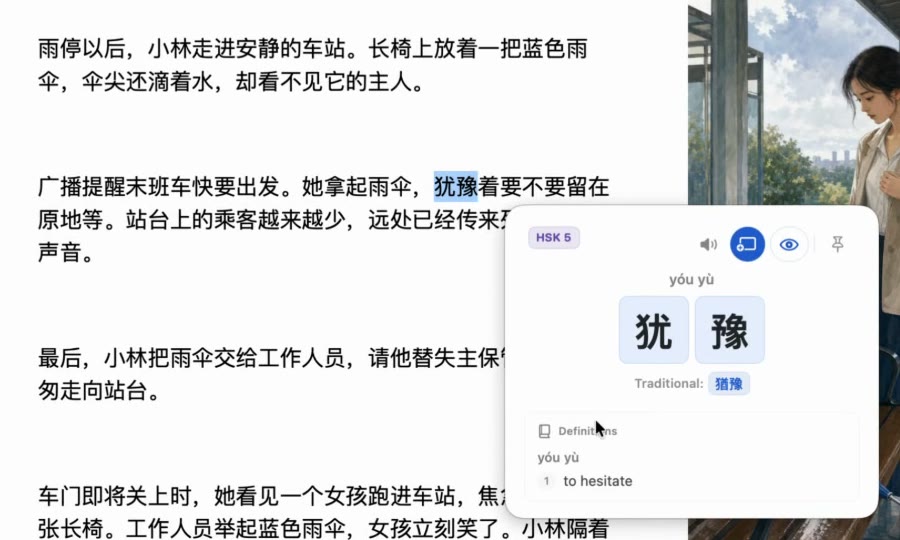
If you read Chinese on a Mac, our app Zhenzhu (made by Minh, who also wrote this guide) shows the HSK level of any word you select or hover over, and a setting switches between the new 1–9 standard and the old 1–6 one. It uses the same HSK level table this comparison started from. It isn't needed for anything in this guide; the checker and the level pages are free and run in your browser.
The exam itself
This guide is about vocabulary, but a few format facts from official and centre sources are worth knowing:
- Chinese Testing International describes the new HSK as "three stages, nine levels" covering listening, speaking, reading, writing and, at the advanced levels, translation. It also says question types, the number of questions, test length and listening speed were adjusted.
- The syllabus took effect in November 2025, and a first global pilot exam ran on 31 January 2026 at centres in 168 countries.
- HSK 2.0 sessions still run until the switch. The University of Sheffield's Confucius Institute, for example, lists an HSK 2.0 session on 5 December 2026. Check your own centre's calendar, since the last 2.0 date varies.
How we counted
We used the HSK level table that ships with Zhenzhu: HSK 3.0 levels extracted from the official syllabus PDF, and HSK 2.0 levels from the MIT-licensed complete-hsk-vocabulary project. Pinyin and meanings come from CC-CEDICT. Three corrections changed the raw numbers slightly:
- Missing words restored. Our table's Level 7-9 list stopped early in the alphabet: it had almost no words from 自然而然 (zì rán ér rán) to 做主 (zuò zhǔ). We restored those 72 words from complete-hsk-vocabulary's own HSK 3.0 data, which agrees with our table on all 9,985 words both of them level.
- Spelling variants merged. Nine words are spelled differently in the two lists, and counting them twice would show them as "dropped" and "new". 面条 became 面条儿, 聊天 became 聊天儿, 桔子 became 橘子, 片断 became 片段, and a few lost or gained an erhua 儿. We merged pairs only when CC-CEDICT gives both spellings the same reading.
- One row per written word. Each written word has one level, and Levels 7-9 count as a single level.
Before these corrections the raw table gave 2,425 changed words, and its HSK 3.0 Level 1 split as 143 old Level 1, 55 old Level 2, 11 from Levels 3–5 and 91 not in HSK 2.0. Those are the figures you may see quoted elsewhere; the corrected ones are used throughout this page. The HSK 2.0 list is nominally 5,000 words; we count 4,991 distinct ones because a few words, such as 得 and 长, appear twice.
Limits: HSK lists assign a level to a written word, not to a meaning, so 行 (xíng or háng) has one level for both. And the level tells you when the exam expects a word, not how common it is in what you read.
Sources: Chinese Testing International, About HSK; University of Sheffield Confucius Institute, HSK tests (launch date and the 5 December 2026 HSK 2.0 session); HSK Mock, on CTI's September 2026 announcement (HSK 3.0 standard from 2027); Beijing municipal government, pilot exam notice; Wikipedia, Hanyu Shuiping Kaoshi (2021 and 2025 word counts); CC-CEDICT (CC BY-SA 4.0).
How this guide was made: research, data analysis and drafting were AI-assisted. Every count was computed from the word lists by a script in our repository, and dates, Chinese examples and product claims were checked against the sources above, CC-CEDICT and our HSK level table.
Read Chinese on your Mac without friction
Selection lookup, on-device OCR, pinyin tone marks, HSK context, and 1-click Anki export. Try Zhenzhu Free today on macOS 15+.