
To read manhua in Chinese without constant friction, start with a free vertical-scroll webtoon, pick a modern slice-of-life or school story, and pair it with an OCR tool for the speech bubbles. Browser popup dictionaries cannot read text baked into images, so you need a screen-reading step. This guide covers where to read legally, which genres fit HSK 3–5 learners, and how to look words up cleanly on phone or desktop.
Why manhua is a strong bridge into native reading
漫画 (mànhuà, comics) put dialogue first. Each speech bubble is short, and the character's expression tells you right away whether a line is angry, embarrassed, or sarcastic. That visual context lets you follow the plot even when you miss 20% to 30% of the words.
The phrasing is also close to everyday spoken Mandarin. Instead of the literary prose you meet in a long novel, manhua gives you natural reactions, fillers, and conversational connectors that rarely show up in textbook dialogues.
There is one technical catch. Native manhua are published as flat image files with no built-in pinyin. Browser extensions like Zhongwen, Zhongzhong, Frill, and Yomitan only inspect selectable DOM text in a webpage, so hovering over a speech bubble does nothing.
Where to read manhua in Chinese legally
Mainland platforms (mostly Simplified Chinese)
Three major Mainland platforms dominate native Chinese webtoons: Kuaikan Manhua, Bilibili Manga, and Tencent AC.QQ. Note that Bilibili's separate international English app (Bilibili Comics) shut down on February 29, 2024, while its domestic Chinese platform Bilibili Manga remains active.
Expect some account friction outside China. Locked or paid chapters usually require a Mainland account and WeChat Pay or Alipay, and some features prompt for phone verification. Free opening chapters and free-to-read series give you plenty of material to practice before you ever worry about paid coins.
Easier-access portals
LINE Webtoon Traditional Chinese is free to browse in a standard browser and uses vertical scrolling without requiring Mainland phone verification. Because it publishes in Traditional characters, verify you are comfortable with that script first. Dongman is the companion Mainland portal for Simplified Chinese webtoons.
How to pick your first title (and genres to avoid)
Genres to start with
When browsing tags on Kuaikan, AC.QQ, or LINE Webtoon, look for modern everyday categories:
- 日常 (rìcháng, daily / slice-of-life)
- 校园 (xiàoyuán, campus / school life)
- 搞笑 (gǎoxiào, funny / comedy)
- 言情 (yánqíng, modern romance)
In these genres, bubbles stay short and characters repeat the same greetings, complaints, and teasing phrases across chapters—ideal repetition when you are building reading speed.
Genres to skip at HSK 3–4
Hold off on 武侠 (wǔxiá, martial arts chivalry) and historical or cultivation fantasy early on. Archaic pronouns, weapon names, and sect titles force constant lookups of rare vocabulary you will rarely use in daily Mandarin.
Modern suspense, tagged 悬疑 (xuányí, suspense), sits cleanly in the middle. Try it once short contemporary dialogue feels comfortable.
Why vertical-scroll webtoons beat print scans
Modern Chinese webtoons stack large, full-color panels vertically with horizontal text inside clean white speech bubbles. Compared with dense, low-resolution black-and-white print scans, horizontal webtoon bubbles are noticeably easier both for human eyes and for OCR engines.
First-series decision checklist
- The dialogue runs horizontally inside clean bubbles.
- The story takes place in a contemporary setting.
- Most bubbles hold one or two short sentences, not walls of exposition.
- You recognize at least 70% of the characters on the first episode without opening a dictionary.
If a comic fails two items on that checklist, bookmark it for later and pick an easier series.
How to look up characters inside comic images
On Kuaikan, Bilibili Manga, AC.QQ, and LINE Webtoon, every episode loads as JPEG, PNG, or WebP image strips. Because there is no HTML text underneath, DOM popup extensions cannot see the characters. You need an OCR workflow matched to your device:
| Device | Practical setup | What to know |
|---|---|---|
| Android | Pleco with the paid OCR add-on and floating Screen Reader | Lets you tap characters directly over live comic apps. The OCR add-on is about $9.99, or bundled in Pleco's Basic Bundle ($24.99 on Pleco's web store, $29.99 in-app). |
| iPhone / iPad | Apple Live Text, or screenshots into Pleco Still OCR | iOS sandboxing blocks third-party floating screen readers over other apps, so you capture screenshots first. |
| Mac | macOS Live Text in Preview/Safari, generic screen translators, or Zhenzhu (our app) with on-device snip OCR | Live Text is free but lacks word-by-word HSK breakdown and flashcard mining. Zhenzhu's Mac workflow is detailed below. |
| Windows / cross-platform | Screenshot OCR tools, or LunaTranslator / Yomininja-style wrappers | More initial configuration, but works across any browser comic reader. |
Pleco remains mobile-only (iOS and Android), with no official Mac or Windows desktop release yet. On a Mac running macOS Sequoia, iPhone Mirroring can act as a workaround if you already own Pleco add-ons on iOS. For a broader device-by-device comparison, read our guides on Chinese screen translators and Pleco for Mac.
Worked example: breaking down a speech bubble and skipping SFX
Here is how a realistic two-bubble slice-of-life exchange looks when you read actively without over-mining.
Bubble 1
你到底想怎么样? (Nǐ dàodǐ xiǎng zěnmeyàng?, "What on earth do you want?")
- Capture the speech bubble with your OCR tool and read the line once while looking at the character's expression.
- Check 到底 (dàodǐ, HSK 4, after all / on earth). Here it supplies the impatience in the question.
- Verify 怎么样 (zěnmeyàng, HSK 1, how / what about). Even though the word is familiar, seeing it inside an irritated question anchors the natural collocation.
你到底想怎么样?
Target word: 到底 (HSK 4)
到底 (dàodǐ): after all; in the end; on earth
"What on earth do you want?"
Bubble 2
算了,别管他。 (Suàn le, bié guǎn tā., "Forget it, don't mind him.")
- Look up 算了 (suàn le, HSK 6, forget it / let it pass)—an everyday spoken phrase worth saving if it is new to you.
- Let the panel art carry the rest: seeing one character turn and walk away makes the dismissal obvious without dissecting every syllable.
Common mistakes to avoid
- OCR-ing handwritten sound effects: Stylized 拟声词 (nǐshēngcí, onomatopoeia) and background art text confuse OCR engines and add almost zero useful vocabulary. Skip them.
- Mining every unknown word: Save only sentences with one clear unknown word (i+1) rather than every 生词 (shēngcí, new word) on the page. Too many cards turn comic reading into homework.
- Mixing up scripts mid-series: Confirm whether your platform serves 简体 (jiǎntǐ, simplified characters) or 繁体 (fántǐ, traditional characters) before committing to a long run.
A smoother Mac reading and mining workflow (with Zhenzhu)
If you read webtoons on a Mac, Zhenzhu is our native macOS 15+ menu bar app built by solo developer Minh to handle both selectable text and pixel-based comics without switching apps.
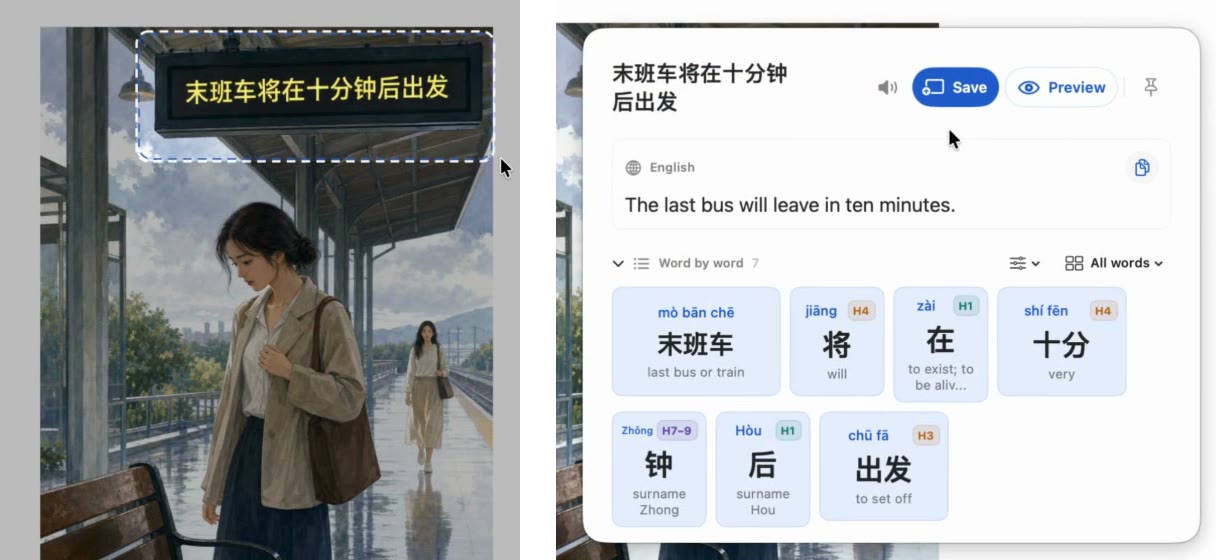
How the desktop flow works
- Open Kuaikan, LINE Webtoon Traditional Chinese, or AC.QQ in Safari or Chrome and scroll normally.
- When a speech bubble stops you, press your global
Snip to Translateshortcut and drag a box tightly around that bubble. - Apple Vision OCR runs on-device, so screenshots stay on your Mac instead of going to a cloud server.
- Zhenzhu segments the recognized line into clickable words with tone-marked pinyin, HSK levels, CC-CEDICT definitions, and speech.
- If the line is a keeper, one click saves a sentence card—complete with the captured bubble image—to Zhenzhu's built-in FSRS decks or to Anki over AnkiConnect.
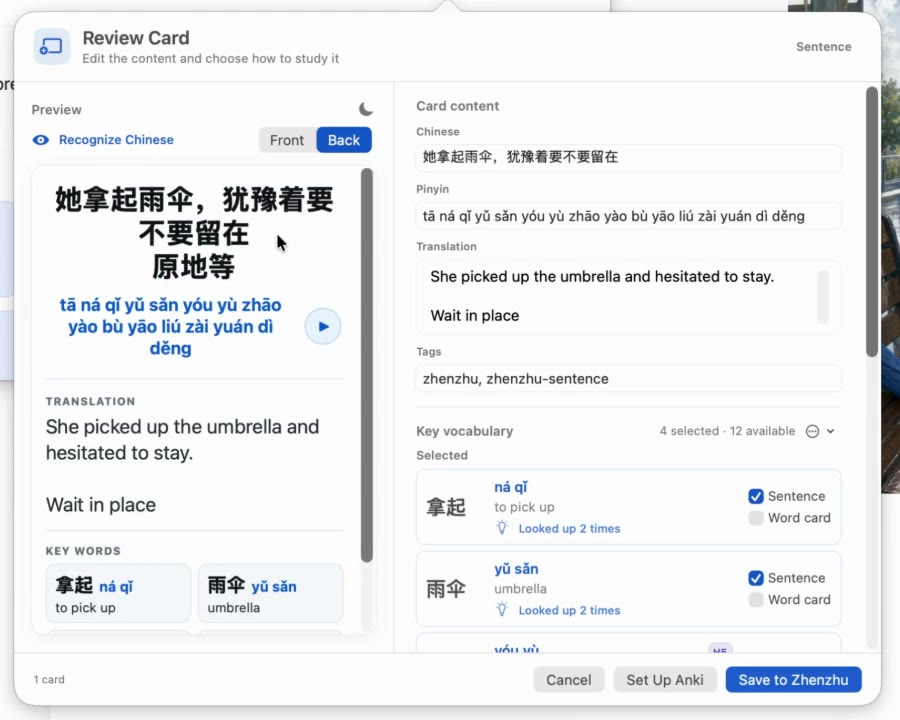
Dictionary lookups, on-device Apple Vision OCR, history, and local FSRS flashcards work locally on your Mac. Sentence translation and speech depend on macOS language downloads, so fetch those in System Settings before reading offline. A Windows version is currently on the waitlist and is not released yet.
Free vs Pro
| Feature | Free | Pro |
|---|---|---|
| Price | Free download, no account, no trial | $29 USD one-time (covers 3 Macs and all future updates; $9 Black Friday price with code BF2026 through Dec 1, 2026) |
| Text lookups | Unlimited dictionary lookups, sentence translation, HSK breakdown, speech | Unlimited |
| Mining & OCR | 15 new mined cards and 20 OCR reads per month | Unlimited mining, OCR, decks, import/export, and Anki automation |
| Review & history | Unlimited reviews, latest 30 history entries, 1 deck, card export | Unlimited history, decks, and full FSRS settings |
Twenty OCR reads cover a few careful chapters a month if you rely mostly on context and only snip the bubbles that truly block comprehension.
A realistic weekly manhua routine
Keep sessions short—15 to 20 minutes, or about one to two chapters at a time. Consistent daily reading beats an exhausting weekend sprint and keeps the 故事 (gùshi, story) fun.
Split each chapter into two passes: read most bubbles for plot flow using the artwork, and save only 5 to 8 high-frequency conversational lines per chapter. If you find yourself sniping every second bubble, step down to an easier slice-of-life title until reading becomes a comfortable 习惯 (xíguàn, habit).
When comics start feeling easy and you want longer prose, move on to our guide on reading Chinese web novels. For setting up clean spaced-repetition cards from your reading, see our Chinese sentence mining and Anki workflow for macOS, or compare desktop OCR utilities in our Chinese screen translator guide.
How this guide was made
Research and drafting for this guide were AI-assisted; Chinese vocabulary examples, pinyin, and HSK levels were checked against CC-CEDICT and HSK level tables, and platform details plus Zhenzhu's features and pricing were verified against official documentation and pricing configuration as of November 2026.
Read Chinese on your Mac without friction
Selection lookup, on-device OCR, pinyin tone marks, HSK context, and 1-click Anki export. Try Zhenzhu Free today on macOS 15+.